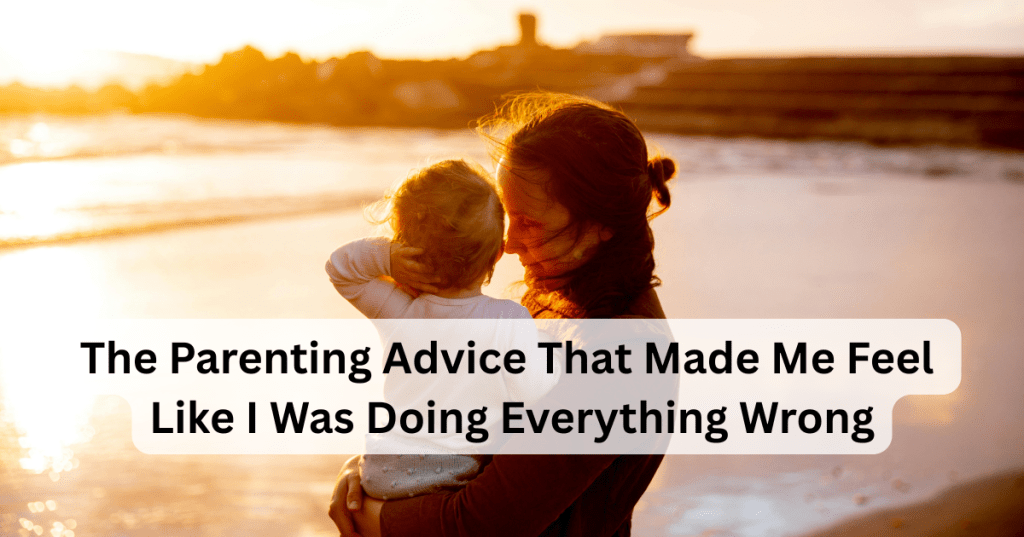
There’s a moment many parents don’t talk about.
You’re already tired. You’re trying. You’re reading, listening, learning. And then you hear a piece of parenting advice that lands not as guidance, but as a quiet accusation.
Suddenly, you’re questioning everything.
Am I doing this wrong?
Did I already mess my child up?
Why does everyone else seem to know what they’re doing?
This article isn’t about blaming parenting advice itself. Some of it is thoughtful and helpful. But some of it (especially when taken without context) can leave parents feeling like they’re failing at the most important job they’ll ever have.
When Advice Stops Being Helpful
Parenting advice is everywhere.
On social media.
In books.
From well-meaning family members.
From strangers who watched a five-second moment of your life.
Much of it comes wrapped in certainty.
“If you do this, your child will turn out like that.”
“If you don’t do this, you’re harming them.”
“A good parent would never…”
And that’s where the problem begins.
Because parenting doesn’t happen in a vacuum. It happens in real homes, with real children, real exhaustion, real histories, and real limits.
Advice that ignores context doesn’t guide, it shames.
The Advice That Made Me Doubt Myself
The advice that hurt the most wasn’t loud or cruel. It sounded responsible. Educated. Well-intended.
It was the kind that implied:
- If your child has big emotions, you didn’t respond correctly
- If your toddler melts down, you didn’t prepare them enough
- If your child struggles, it’s because you missed something
Slowly, quietly, I began to believe that every hard moment was proof I was doing something wrong.
Instead of asking, What does my child need right now?
I asked, What did I do wrong?
That shift matters more than we realize.
Why This Kind of Advice Is So Heavy
Parents already carry an invisible weight.
We worry about:
- Our tone
- Our reactions
- Our patience
- The long-term impact of ordinary days
Advice that frames parenting as a series of irreversible mistakes feeds anxiety, not growth.
It teaches parents to fear normal struggles instead of understanding them.
Children aren’t projects to perfect. They’re humans learning how to exist in the world, and that learning is often messy.
What Helped Me Reframe Everything
What changed wasn’t better advice.
It was permission.
Permission to:
- See challenges as communication, not failure
- Understand that skills develop over time
- Accept that no response is perfect, only responsive
I started asking different questions:
- Is my child safe?
- Is my child loved?
- Am I trying to respond with care, even when I fall short?
Those questions grounded me when advice felt overwhelming.
The Difference Between Support and Pressure
Support sounds like:
- “This is hard. You’re not alone.”
- “There are many ways to handle this.”
- “You can learn and grow alongside your child.”
Pressure sounds like:
- “If you don’t do this now, you’ll regret it.”
- “A good parent would know better.”
- “This will damage them.”
Parenting kindly doesn’t mean ignoring guidance.
It means choosing advice that builds confidence instead of fear.
Your Child Doesn’t Need a Perfect Parent
They need:
- Someone who shows up
- Someone who repairs
- Someone who keeps learning
They don’t need flawless responses or textbook days.
They need relationship. Safety. Presence.
And you are allowed to grow into that, not prove it all at once.
If You’ve Ever Felt This Way
If parenting advice has ever made you feel small, anxious, or inadequate, this is your reminder:
What you’re experiencing is not a sign of incompetence, it’s a sign that you’re parenting a real, developing human.
You are learning.
You are responding in real time to a real child.
That matters more than following anyone else’s script.
A Gentle Closing Thought
The most helpful parenting advice isn’t the kind that tells you what you’re doing wrong.
It’s the kind that helps you trust yourself enough to keep going.
And if you’re here—reading, reflecting, trying—then you already are.






 Parenting Kindly